
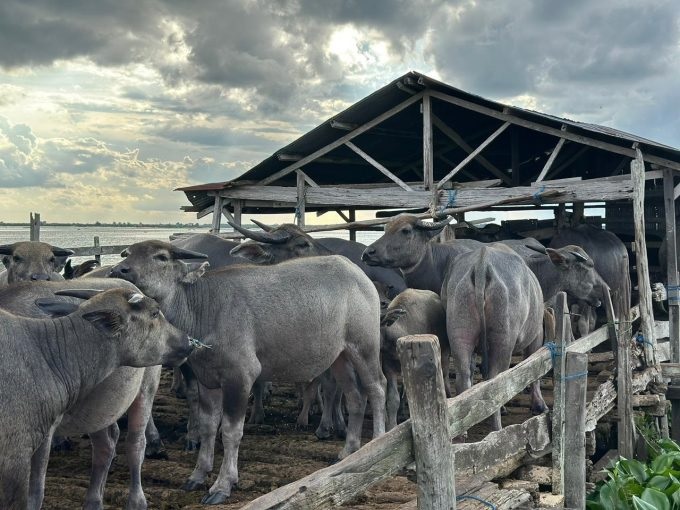
The Faculty of Animal Science Universitas Gadjah Mada (Fapet UGM) with Prof. Dr. Ir. Tri Satya Mastuti Widi, S.Pt., M.P., M.Sc., IPM., ASEAN Eng., conducted a research entitled “Development of a Sustainable Buffalo Production System Based on Local Wisdom for National Food Self-Sufficiency )Kerbau untuk Indonesia/KuI)”.
The research was conducted from May to November 2024 in production system of Gayo Buffalo at Gayo Lues Regency, Province of Aceh; Tapanuli buffalo at Toba and Samosir Regency, Province of North Sumatra; and Kalang Buffalo at Hulu Sungai and Hulu Sungai Selatan, Province of South Kalimantan. The research is a collaboration under the katalis scheme (Strategic research Collaboration), which involved Universitas Malikussaleh, Aceh; Universitas Sumatera Utara, Medan; and Universitas Lambung Mangkurat, Banjarbaru, Kalimantan Selatan.
Buffalo and Sustainability Challenges
According to Tri Satya Mastuti Widi, shortly called Vitri, buffalo is one of the strategic livestock in Indonesia which plays a crucial role in supporting national food self-sufficiency, both through meat and milk production, the provision of agricultural labor, as well as social, cultural, and ecological values. In several regions, buffalo have even become their identity and part of the collective culture of the local community. In South Kalimantan, Kalimantan Buffalo or often called Kalang Buffalo also functions to to maintain swamp ecosystems and support wetland conservation.
“Unfortunately, the population of buffalo in Indonesia keeps decreasing from year to year. This condition is affected by low productivity, dominance of extensive and traditional rearing systems, conversion of grazing land, conflicts over space utilization, as well as the weak institutional capacity of livestock farmers,” stated Vitri, Monday (5/1).
The research employed a holistic, integrated approach to assess and build a sustainable buffalo production system. The analysis focused on three sustainability dimensions: economic, ecological, and social, at various levels of the production system, ranging from the livestock and the farmer to the zone.
Meanwhile, the main focuses of the research include four aspects: analysis of genetic diversity, phenotypic characteristics, and sustainability of the Kalang buffalo production system; design of a sustainable swamp buffalo production system using a systems approach in South Kalimantan; holistic and integrated analysis and assessment of the sustainability of the Gayo, Tapanuli, and Kalang buffalo production systems; and transformation of the Gayo and Kalang buffalo production systems toward more sustainable systems.
Through the measurement of the sustainability status, the research produced various designs and scenarios for buffalo production system development that are oriented toward increasing productivity, preserving the environment, and strengthening the socio-cultural role of buffalo in each area.
From this research, several publications have been compiled, along with a Policy Brief titled “Ethnosilvopasture for Gayo Lues: An Initiative for the Development of Sustainable Buffalo Farming Based on Local Wisdom”. Up to this point, research on buffalo, particularly in Gayo, Tapanuli, and South Kalimantan, has been continuously conducted using the application of modeling and scenarios for sustainable buffalo production systems.
Original article: https://fapet.ugm.ac.id/fapet-ugm-dorong-kemandirian-pangan-nasional-melalui-penelitian-kerbau-berbasis-kearifan-lokal/
Translated by: Merlin Fatika Ramadhani