
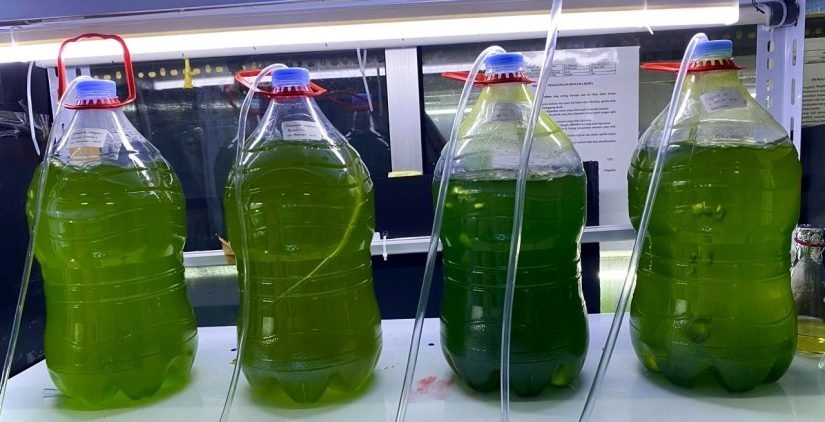
Waste management and usage is a responsibility of the livestock farming industry to conduct a business establishment that is not only profit-oriented, but also sided with the community and environment. Coming from that, a number of UGM researchers conducted research showing that bio-slurry as the liquid waste from biogas production could be used optimally as a medium for Euglena sp. IDN 22 microalgae that has a potential to be raw material for various industries.
The team that was led by a professor at the Faculty of Animal Science of UGM (Fapet UGM), Prof. Ir. Ambar Pertiwiningrum, M.Si., Ph.D., IPM., ASEAN Eng., and is consisted of Prof. Ir. Nanung Agus Fitriyanto, S.Pt., M.Sc., Ph.D., IPM., Dhomas Indiwara Prana Jhouhanggir (doctoral student at Fapet UGM), and Dr. Eko Agus Suyono, S.Si., M.App.Sc. (lecturer and researcher, Faculty of Biology UGM). The research was published in the Journal of Ecological Engineering in the 2025 edition.
Ambar explained that the integration of bio-slurry utilization and microalgae cultivation proposes two advantages, that is economical and ecological. From the economic standpoint, bio-slurry contains important nutrients such as nitrogen (N), phosphorus (P), and kalium (k) that is necessary for microalgaes. This enables farmers to reduce or even eradicate the need for synthetic fertilizers, further lowering the operational cost in microalgae cultivation.
From the ecological standpoint, the usage of bio-slurry could reduce the farming waste contamination load. Liquid waste from the biogas production contains nutrients such as nitrogen and phosphorus that could enable eutrophication if it is directly discarded into the water surface without any treatments.
“By processing it into microalgae cultivation medium, the waste residue reduces significantly, lowering greenhouse gas emissions such as methane (CH₄) and nitrous oxide (N₂O), while also supporting the circular economic principle and environment sustainability,” said Ambar, Monday June 30th.
He adds that the waste management using this approach is considered to be more environmentally friendly for it eradicates the need to add synthetical chemical substances during the treatment processes. Bio-slurry is used in its natural state as a medium for microalgae cultivation. This approach avoids the potential of secondary contamination that usually is caused by the chemical waste of production, and also keeps the surrounding ecosystem integrity.
“Other than that, the use of microalgae in this system also contributes to absorption of carbon dioxide (CO₂) and elimination of excess nutrients, such as nitrogen and phosphorus, that could cause eutrophication if it is discarded into the water surface,” said him.
Ambar acknowledges that the microalgaes biomass production currently is not common enough for farmers or farming groups in Indonesia. Some initiatives have been started, especially in the academic community, biotechnology startups, and community empowerment-based projects, but the scale of it is still limited. The main issue is the lack of information obtained by the farming groups regarding the technical means and potential of microalgae cultivation, worsened by the limited market access.
As the continuation of this research, said Ambar, the team is conducting further research to decide the most optimal bio-slurry composition based on the nutritional value, namely the ratio of carbon compared to nitrogen (C/N), that directly affects the growth and productivity of microalgaes.
Original article: Peneliti Fapet UGM Integrasikan Bio-slurry Untuk Kultivasi Mikroalga Sebagai Solusi Pengelolaan Limbah Peternakan Ramah Lingkungan
Translated by: Widadullah Ragid Addiraya