
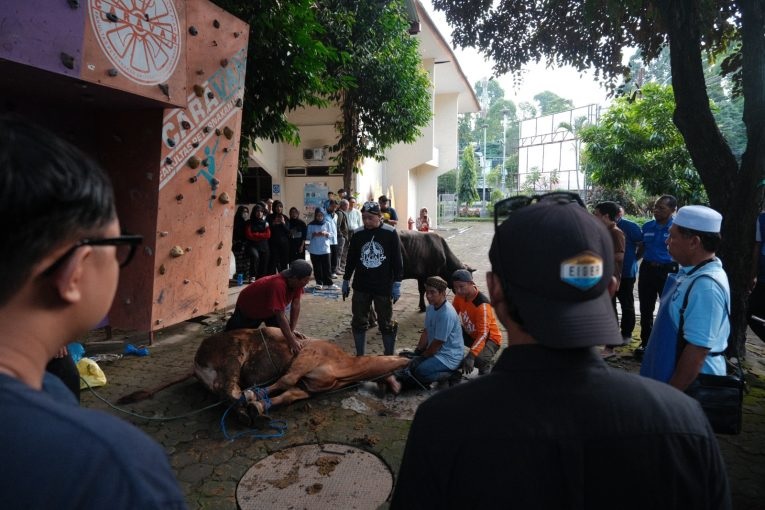
The Faculty of Animal Science Universitas Gadjah Mada (Fapet UGM) held its annual Eid al-Adha sacrificial slaughter by processing four cattle and five sheep on campus on Friday (29/5). The event involved faculty members, students, administrative staff, and the Eid al-Adha organizing committee, who worked together throughout the slaughtering process and the distribution of the meat to the Fapet UGM community.
Chair of the Fapet UGM Eid al-Adha Committee, Dr. Ir. Agussalim, S.Pt., M.Sc., IPM., ASEAN Eng., explained that this year’s event served not only as an act of worship but also as an educational opportunity to demonstrate proper halal slaughter practices and humane animal handling.
“The Eid al-Adha slaughter at Fapet UGM is carried out in accordance with the principles of being halal, safe, ihsan, and well-organized. By involving members of the academic community, the event also provides hands-on learning about proper livestock handling and slaughter techniques in line with both Islamic law and animal welfare standards,” he said.
During the event, Ir. Cuk Tri Noviandi, S.Pt., M.Anim.St., Ph.D., IPM., ASEAN Eng., a lecturer at Fapet UGM, provided a live demonstration and explanation of the correct techniques for handling and slaughtering sacrificial animals.
He explained that, under Islamic halal slaughter requirements, four essential structures must be severed: the trachea (hulqum), the esophagus (mari’), and the two major jugular blood vessels (wadajain). The incision should be made just behind the Adam’s apple using an extremely sharp knife to ensure rapid blood drainage and a swift, humane slaughtering process.
“The slaughter should be performed with a single, effective motion using a very sharp knife. The guiding principle is simple: the sharper the knife, the quicker the process,” Cuk explained.
Author: Satria
Photo: Media Center Team
Translated by: Merlin Fatika Ramadhani
Original article: https://fapet.ugm.ac.id/fapet-ugm-sembelih-4-sapi-dan-5-domba-kurban-terapkan-teknik-halal-aman-dan-ihsan/