
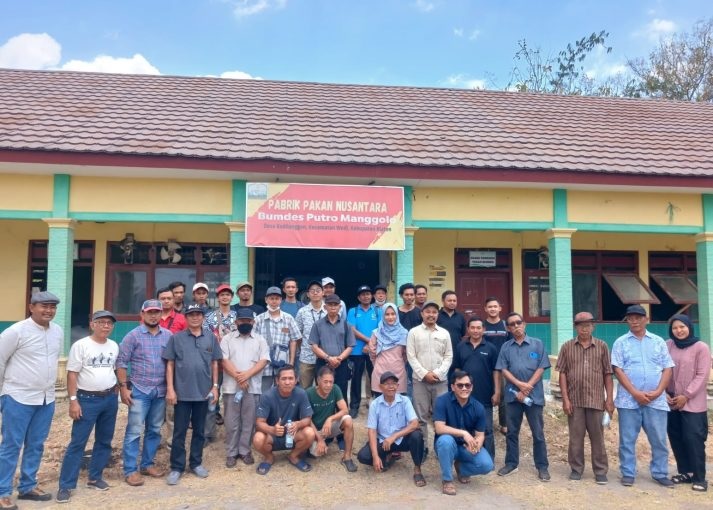
The Faculty of Animal Science at UGM, in collaboration with the Village-Owned Enterprise (BUMDes) Putro Manggolo in Kadilanggon Village (Wedi District, Klaten Regency), continues to demonstrate tangible contributions to rural community empowerment through the livestock sector. Supported by a multi-year community service grant from the Ministry of Higher Education, Science, and Technology (specifically the Directorate General of Research and Development) spanning 2023 to 2025, the program has successfully accelerated the transformation of BUMDes into a driver of the productive economy. Simultaneously, it has strengthened Kadilanggon Village’s status as a Food Self-Sufficiency Area, a designation established by the Central Java Provincial Government.
Kadilanggon Village, covering nearly 200 hectares with a population exceeding 5.000, possesses a strong agricultural base (rice, corn, and soybeans), yet its livestock sector had previously been managed using traditional methods. Through synergy with UGM and the support of the grant program, this potential is now evolving into a new, sustainable economic force.
BUMDes Transformation
The development of BUMDes Putro Manggolo is structured into three continuous main stages: foundation, optimization, and acceleration.
“The foundation we have built since 2023 ensures that the BUMDes stands on solid ground. During the optimization stage, we increased production and improved management. Now, through the acceleration phase, we aim to establish the BUMDes as the village’s economic hub via the Kampung Domba (Sheep Village) Program, which actively involves the wider community,” said Adi Imam Adi Prayogo, Director of BUMDes Putro Manggolo, on Monday (22/9).
UGM’s Role in Technology Transfer
This program receives direct guidance from a team from the UGM Faculty of Animal Science led by Dr. Muhsin Al Anas. Through technology transfer, the team ensures that the management of the Village-Owned Enterprise (BUMDes) is capable of producing standardized quality feed using an entrepreneurial approach. Concentrate feed technology based on Rumen Undegradable Nutrients (RUNs), developed through research by the Faculty, has been introduced to enhance the efficiency of livestock farming operations.
“For us, community service is not merely about imparting knowledge; it is about delivering tangible, research-based solutions. BUMDes Putro Manggolo serves as an example of how university research can be translated into practical application to boost the productivity of smallholder livestock farming while strengthening the village economy. Furthermore, this program is expected to serve as a concrete step contributing to national food sovereignty,” stated Muhsin Al Anas.
Additionally, UGM students are actively involved through the Merdeka Belajar Kampus Merdeka or MBKM (Freedom to Learn, Independent Campus) program, turning this community service initiative into a platform for contextual learning for the younger generation in the fields of sustainable livestock farming and the productive economy. The service program in Kadilanggon Village has even served as a learning opportunity for students from Universiti Putra Malaysia and facilitated the development of a collaboration with the Northern Territory Cattlemen’s Association (NTCA) in Australia.
Tangible Impact on the Village
To date, the BUMDes Putro Manggolo concentrate feed mill has the capacity to produce 50-75 tons per month. This business unit employs 8-9 villagers, providing incomes equivalent to the regional minimum wage, and regularly contributes to the Village’s Own-Source Revenue (PAD). The Kampung Domba (Sheep Village) program, a key focus for 2025, aims to engage livestock farming partners from Kadilanggon Village with a target population of up to 100 sheep. Utilizing a nucleus-plasma partnership model, BUMDes acts as the off-taker and feed supplier, while the Faculty of Animal Science at UGM provides high-quality breeding stock, and farmers handle livestock rearing according to established standards. This model is expected to broaden socio-economic impacts while strengthening food security.
The collaboration between the university and the village government serves as a concrete example of translating research into practical applications for community welfare. The development of BUMDes Putro Manggolo has not only established a feed mill but has also created a productive, independent, and sustainable economic ecosystem. Kadilanggon Village is envisioned as a model for a food-producing area that can be replicated in other regions.
Towards Village Economic Self-Reliance
With the support of academics and the village government, alongside community participation, BUMDes Putro Manggolo is now making confident strides toward self-reliance. This program demonstrates that synergy between universities and villages, backed by government support, can drive innovations that deliver tangible benefits for food security and rural well-being.
Looking ahead, the success achieved by Kadilanggon Village is expected to extend beyond its current milestones. The Kampung Domba (Sheep Village) program and the concentrate feed production managed by BUMDes Putro Manggolo must be further strengthened. The goal is to establish a sustainable model of village empowerment that creates a broader community impact while inspiring other villages across Indonesia.
“We hope that Kadilanggon Village can serve as a living laboratory for small-scale livestock innovation, a place where research, technology, and local wisdom converge to build a future of village self-reliance and prosperity,” asserted Muhsin Al Anas.
Buoyed by a solid foundation, continuous optimization, and visionary acceleration, Kadilanggon Village has established itself as a pioneer in realizing a food-independent village driven by livestock farming.
Original article: https://fapet.ugm.ac.id/bumdes-putro-manggolo-cerita-sukses-desa-kadilanggon-membangun-ekonomi-produktif-melalui-peternakan/
Translated by: Sarah Suminar