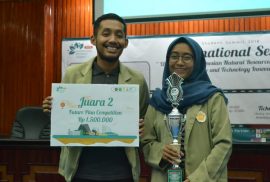
Because of the idea of ββan information-spatial technology-based system to support waste processing, Faculty of Animal Science (FAS) students, Muhammad Alfin Huda, won 2nd place in the Future Scientific Competition 2018 in the Scientific Writing Competition (LKTI) on October 5-6 2018. In the competition, Huda collaborated with Septi Mooi Cahyani, a student of the Urban and Regional Planning Department of the Faculty of Engineering UGM and Anisah Bella Istiqomah, a student of the Department of Economics, Faculty of Economics and Business UGM. The scientific work they compiled was entitled “SPLITTER (Farmer Waste Management System) Taman Agung Village as Belitang Indpendent Integrated City (KTM) Economic Revitalization Effort”.
Faculty News
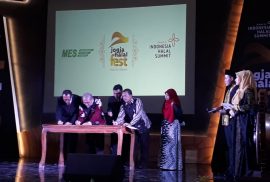
The Faculty of Animal Science (FAS) UGM and the Daerah Istimewa Yogyakarta (DIY) Sharia Economic Community collaborate in the field of halal socialization and education. The joint memorandum of understanding was signed on Thursday (11/10) at the Jogja Expo Center.
“In livestock, halal and tayib (good) food is important. Food that is halal and tayib does not merely reap blessings spiritually, but also in harmony with the spirit of food security and safety. In the end, this leads to a healthy life and blessings,” said Vice Dean for Research, Community Service and Collaboration of FAS UGM, Bambang Suwignyo, S.Pt., MP, Ph.D when being interviewed at FAS UGM after the signing of the MoU.
The excessive use of antibiotic and growth promoter (AGP) is a challenge for the world of livestock industry in Indonesia. AGP stimulates bacterial and residual resistance stored in livestock products (meat, milk, eggs) are harmful to human health because they cause pathogenic bacterial resistance. Food and Agriculture Organization notes that the use of antibiotics in agriculture reaches 63,000-240,000 tons every year.
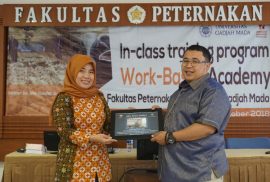
“The challenge is getting harder with the low purchasing power of Indonesian people towards livestock products. “Among the 260 million of Indonesians, only 30 million people have high purchasing power,” said the Dean of the Faculty of Animal Sciences UGM, Prof. Dr. Ir. Ali Agus, DAA., DEA., IPU when delivering a presentation in the in-class training of Work-Based Academy on Monday (1/10) at Faculty of Animal Science UGM.
The increasing population of Indonesia and the increasing urbanization flow to 6.6% in 2035 has the potential to reduce the number of food producers in rural areas. This will be a challenge for the development of the livestock industry in Indonesia, considering the world’s food needs will increase by 60% due to population growth.
“The population of cattle and buffalo during the period 2010-2014 continues to increase. Even so, there are still challenges in the development of cattle and buffalo,” said Ismatullah Salim, S.Pt., as Subdivisions Head of Accounting, Verification and Follow-Up Monitoring (TLHP), Finance Section of the Directorate General of Livestock and Animal Health, Ministry of Agriculture, Republic of Indonesia. providing in-class training to participants of the Work-Based Academy, Friday (5/10) at the UGM Faculty of Animal Husbandry.
Indonesia as a large archipelago with an area of ββ192 million Ha has 80% of small farmers who own land less than 1 ha and 28 million households with 11.1 million have no land. As many as 50% of the 13 million hectares of food producers (rice) in Java and 50% of farmers are only 21% of the total agricultural land.
“Based on the data, community empowerment needs to be conducted. Communities can be empowered to manage local potentials to achieve prosperity,” said Vice Dean for Research, Community Service, and Collaboration of Faculty of Animal Science (FAS) UGM, Bambang Suwignyo, S.Pt., M.P., Ph.D. when delivering training to participants in the Work-Based Academic in-class training, Monday (1/10) at FAS UGM.