
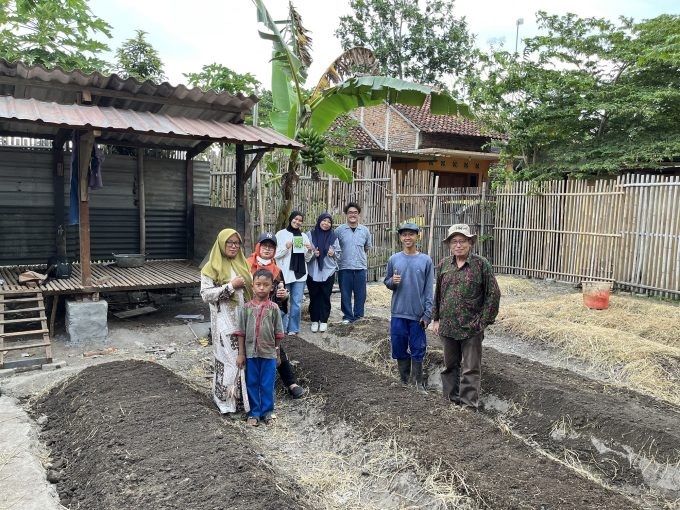
An-Nur Islamic Boarding School in Bantul, one of the largest of its kind in Indonesia, is taking strides toward realizing the concept of a self-reliant and sustainable boarding school. In collaboration with a community service team from the Faculty of Animal Science at UGM, led by Prof. Nafiatul Umami from the Forage and Pasture Laboratory, Department of Animal Nutrition, the school has initiated a program integrating maggot waste processing and organic waste management to develop poultry pastures.
This community service program, titled “Empowering Islamic Boarding Schools through the Integration of Maggot Waste Processing and Organic Waste Management for Poultry Pasture Development” was prompted by the massive volume of waste generated by the institution. With 2.500 students, An-Nur Islamic Boarding School produces approximately 500 kg of waste daily; 60% of this, equivalent to 300 kg, consists of organic waste from the kitchen and food scraps.
“Organic waste has previously been managed for conversion into fertilizer, since improper handling could lead to environmental and health issues, but the process has not yet been optimal, turning the waste into a burden. Through this program, we aim to transform that burden into a blessing and a resource with economic value,” said Anis Sulkhan Fadhil, M.Pd, an administrator at the Islamic boarding school, on Tuesday (23/9).
Prof. Bambang Suhartanto, a member of the community service team, explained that the program is designed as a sustainable cycle. “Organic waste is processed by black soldier fly larvae (maggots) into highly fertile frass. We use this frass to enrich the soil and cultivate pasture. The grass from the pasture then serves as highly nutritious feed for the poultry raised at the boarding school, such as chickens and ducks. It is a simple yet powerful circular economy model implemented directly within the boarding school environment,” he explained.
This pilot program is expected not only to reduce waste accumulation at the pesantren (Islamic boarding school) by over 60% but also to lower operational costs for poultry feed, yield healthier and more natural poultry products, create a greener and more pleasant pesantren environment, and equip students with practical, entrepreneurial skills.
Looking ahead, it is hoped that this model, integrating maggot farming with pasture-based systems, will serve as a prototype that can be replicated by other pesantren across Indonesia, fostering the development of self-reliant, environmentally conscious institutions that contribute positively to national food security.
Original article: https://fapet.ugm.ac.id/pemberdayaan-pesantren-melalui-integrasi-pengolahan-limbah-maggot-dan-sampah-untuk-pengembangan-pastura-unggas/
Translated by: Sarah Suminar