
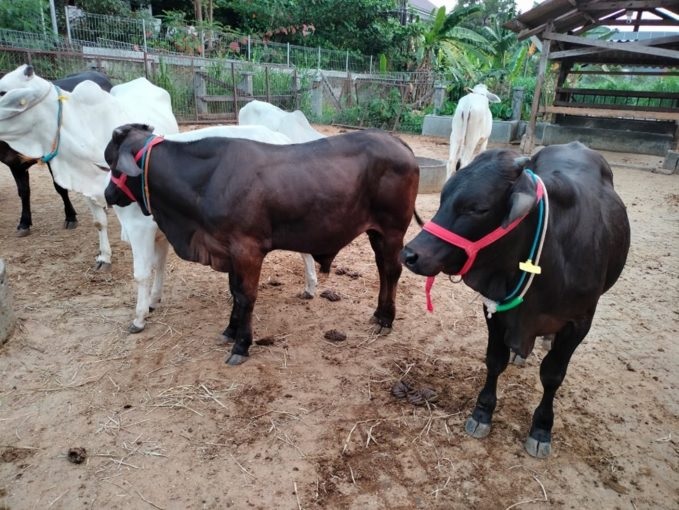
Belgian Blue Cattle, of Belgian origin as the name suggests, is known to have a double muscle caused by the mutation on the Myostatin (MSTN) gen. Seeing the potential of this cattle as an excellent meat source, since 2014 the Faculty of Animal Science of Universitas Gadjah Mada (Fapet UGM) have developed a cross-breeding of the Belgian Blue cattle with a local variety, which was then labelled as Sapi GAMA. This step was done in coordination with PT Widodo Makmur Perkasa and University of Liege. On the other hand, in 2018, the Ministry of Agriculture also introduced the Belgian Blue through embryo transfer and artificial insemination technology, which until now, has produced various cross-bred cattle.
Ir. Tristianto Nugroho, S.Pt., M.Sc., IPP., researcher at Fapet UGM, highlights the important aspect of environment adaptation for this cross-bred cattle. “The Belgian Blue cattle came from a cooler climate region. Added with the relatively small vital organ, that could cause the cattle to be more prone towards heat stress on the Indonesian tropical landscape.” said Tristianto, Monday, June 16th.
According to that, Tristianto conducted a research to map the behaviour of cattle breed from the cross-breeding of Belgian Blue with Ongole cattle. This research was conducted during the height of the dry season, with the cattle being put in an open loose house type barn., where the cattles were let to move around freely without a roof. “The observation was done for 2✕24 hours and was repeated on two different weeks to get the fuller picture of their behaviour,” adds him.
This research was published in the Journal of Animal Behaviour and Biometeorology, an international Q2 journal with 1.8 impact factor. From this research, the researcher team found 73 different types of behaviour that were classified into postural, locomotion and activity, and social behaviour. The study also finds that the cattle spent a relatively balanced time between standing and laying down. Interestingly, 42% of the standing time was spent eating, where bulls were recorded to eat within a shorter period of time compared to cows.
Furthermore, the daily behaviour pattern shows that cattle generally stood from 05.00 AM-05.00 PM, and started to lay down almost the entirety of the night time starting at 10 PM. But, it was recorded that on 10.00-11.00 AM, when the air temperature reached its peak, the cattle was seen to change from laying to standing position. “After the morning feeding, the cattles usually lay to chew their feed. But, because of the sometimes hotter temperature of the floor, the cattle could felt uncomfortable and returning to stand to find a cooler spot to lay down,” explained him.
Tristianto stated that the result of this research could be a basis from Belgian Blue cross-bred cattle rearing management, especially on the aspect of cattle house design that is suitable for tropical climate. He also stated that this research is not done yet and needed more observation. “For now this research is being continued to analyze more deeply regarding each type of behaviour, including comparing it with local cattle varieties,” said him.
On the other hand, Prof. Ir. Panjono, S.Pt., M.P., Ph.D., IPM., ASEAN Eng., member as well as ex-head of the Center of Excellence (CoE) of Sapi GAMA, welcomed this research. “Livestock behaviour could be a good indicator to analyze the environment adaptability,” said him.
The adaptation aspect is one of the main considerations in cattle development. The Belgian Blue cattle has a high meat productivity, but it came from a cooler climate, meanwhile the local breed has a lower productivity but has adapted well with the Indonesian environment. This cross-breeding was done in order to achieve the Belgian Blue genetic level of under 100%, and it is also hoped to produce the complementary effect (combination of excellent traits from the second oldest) and heterosis effect (the betterment of calf’s performance compared to the median of their previous generation). “With these researches, hopefully soon Sapi GAMA could have a stable performance so that it could be accepted and further developed in the public”,”said Prof. Panjono.
Original link: Dosen Fapet UGM Teliti Perilaku Persilangan Sapi Belgian Blue, Ini Hasilnya!
Translated by: Widadullah Ragid Addiraya