
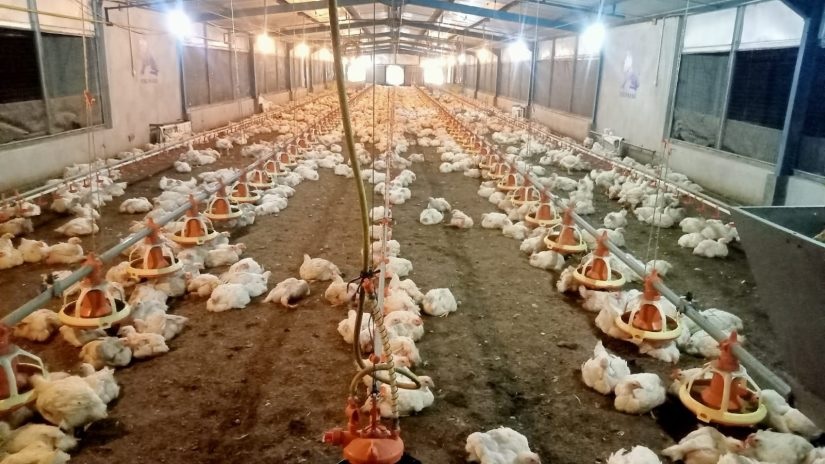
The research team from the Faculty of Animal Science of Universitas Gadjah Mada (Fapet UGM) found that oil derived from the black soldier larvae oil (BSFLO) could reduce the fat content in broiler chickens fed with low protein feeds. These research findings have been published in the journal Poultry Science, a Q1 journal with 3.8 impact factor.
Dr. Muhsin Al Anas, S.Pt., IPP., as the lead researcher, stated that black soldier fly (BSF) could become a solution in future poultry feedsmaking as an alternative additive in order to produce healthier chicken meats.
“We wanted to provide a solution that is not only cost efficient, but also has a positive impact on the health of the chicken, the meat quality, and environment,” stated Muhsin on Friday, June 13th 2026.
In the experiment, as much as 288 broiler chickens were divided into six groups based on the protein level (high, medium, low) and the type of oil (palm oil and BSFLO) contained in the feed. The result showed that although low protein feeds causes loss of weight, the addition of BSFLO could lower that negative impact. As a matter of fact, chickens fed with BSFLO showed a better feed conversion ratio (FCR), a sign of higher efficiency in feed utilization. This efficiency is crucial, mainly because of the rising cost of protein source feed ingredients. “The improvement of the FCR which we studied showed that BSFLO contributes in increasing metabolic energy efficiency in broiler chickens,” continued mUHSIN.
The positive impact of BSFLO use will impact the quality of the chicken meat. The fat pad that is commonly increased in chickens with low protein feeds, lowers significantly on the group that got the BSFLO additive. Besides that, the protein content of the meat also increases while the fat and cholesterol level decreases. The chicken meat produced also has a better water holding capacity when it is cooked, an important indicator in evaluating sensory and physical quality of meat.
Moreover, low protein feed is proven to lower nitrogen and ammonia in chicken litters, these two chemicals is the main cause of air pollution around the broiler house. Although BSFLO does not directly impact litter, the use of it combined with low protein feeds could create a sustainable chicken farming system that is beneficial for the farmers and their livestocks. “This innovation is aligned with the global livestock industry’s target to suppress emission and environmental impact without lowering productivity,” explained muhsin.
Through this research, UGM showed its commitment in supporting national food security through local resources-based research. The utilization of BSF larvaes and the molecular approach implementation became a real example of how livestock innovation could answer challenges in productivity, animal wellbeing, public health, and environmental preservation simultaneously.
Original link: Minyak dari Larva BSF Turunkan Kadar Lemak Ayam Broiler
Translated by: Widadullah Ragid Addiraya