
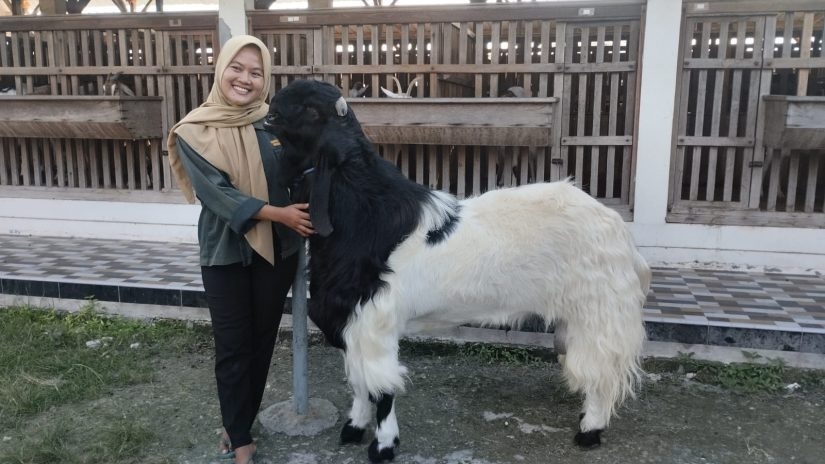
In a corner of Kebonagung Village, Rengel District, Tuban Regency, the distinctive scent of livestock barns blends with the sounds of goats and sheep, becoming part of the daily life of a young woman named Mila Arlinda. The 2021 graduate of the Faculty of Animal Science Universitas Gadjah Mada (Fapet UGM) has successfully built a modern livestock business called Kerabat Ternak 1-3, which has now gained recognition across various parts of East Java.
Amid the perception that livestock farming is predominantly a man’s profession and offers limited prospects for prosperity, Mila has proven otherwise. Together with her husband, Sahroni, she has developed a goat and sheep business with various lines of operation, ranging from fattening and breeding to dairy farming and the sale of livestock production supplies (sapronak).
From what was once a modest operation, Kerabat Ternak now generates hundreds of millions of rupiah in business turnover.
“My family was initially hesitant when I chose to study animal science,” Mila recalled when met at the Kerabat Ternak livestock facility in Tuban.
However, that doubt became a source of motivation for her. Born on January 1, 1999, into a modest family, her father was a wood entrepreneur and her mother a homemaker, Mila grew up with a strong work ethic and learned to be independent from an early age.
Her interest in livestock farming emerged during her teenage years. Long before becoming a university student, when she was in her second year of high school in 2014, Mila began raising five sheep.
That small barn marked the beginning of her long journey.
After completing her studies at Fapet UGM in 2021, Mila decided to focus on developing her livestock business. The knowledge she gained at university did not remain confined to the classroom but was put directly into practice in the field.
For Mila, studying animal science is not merely about theory.
“At Fapet UGM, we were taught not only theory but also practical skills and field experience. That has been extremely helpful when I actually entered the business world,” she said.
During her university years, Mila actively sought firsthand knowledge from lecturers, industry practitioners, and experienced livestock farmers in various regions. She believes that success in livestock farming comes from combining scientific knowledge with practical experience.
“Theory is important, but it is not enough. You have to go directly into the field,” she said.
Her business journey has not always been smooth. The loss of livestock she raised became an important learning experience. Whenever an animal died, Mila would conduct observations to identify the cause and use the findings as lessons to prevent similar incidents from happening again.
Through these experiences, she gained a deeper understanding of livestock health management, ranging from pneumonia caused by temperature changes to various infections commonly affecting goats and sheep.
Today, Kerabat Ternak 1-3 has grown into a livestock business that focuses not only on herd size but also on animal quality and welfare.
In addition to maintaining cleanliness, feed management is taken seriously. Mila manages approximately 1.5 hectares of forage land and supplements the animals’ diets with additional feed such as tofu pulp and dried water spinach to meet their nutritional needs.
Unlike some farmers who prioritize increasing herd size, Mila places greater emphasis on livestock quality and genetics.
The strategy has proven successful. High-quality goats can be sold for between IDR 16 million and IDR 23 million per head, while local goats typically range from IDR 3 million to IDR 5 million.
Kerabat Ternak does not only sell livestock for Eid al-Adha and aqiqah ceremonies but has also expanded into the sale of livestock production supplies, including kid milk, vitamins, and livestock equipment, which are marketed across various regions.
The Eid al-Adha season is one of the business’s peak periods. During the two months leading up to the 2024 sacrificial season, Kerabat Ternak reportedly generated a turnover of between IDR 500 million and IDR 700 million. During regular periods, its aqiqah services, breeding stock, milk, and livestock supply businesses generate approximately IDR 50 million in monthly turnover, in addition to around IDR 75 million from livestock production supplies.
Its livestock market has now expanded to Lamongan, Bojonegoro, and various other areas across East Java.
Beyond livestock farming, Mila has also been actively educating the public about animal husbandry through social media and TikTok since 2023. Her educational content serves as a platform for sharing knowledge while strengthening the image of modern livestock farming as a field that requires both scientific knowledge and practical skills.
Kerabat Ternak has also begun making a social impact in the surrounding community. Mila and her husband currently employ two workers and actively develop livestock farmer groups together with local residents.
One of the beneficiaries is Erma, a member of a livestock group supported by Mila. According to her, the presence of Kerabat Ternak has been particularly helpful to small-scale farmers, especially in distributing goat milk.
“I no longer have to worry about where to sell the milk. I can also learn a lot through the livestock group and at Kerabat Ternak,” she reported.
A similar benefit has been experienced by Agung Setiawan, a vocational student from SMK Negeri 4 Bojonegoro undertaking an internship at the farm. He said he was pleased to have the opportunity to gain firsthand experience there.
“I have learned a lot during my internship here,” he admitted.
For Mila, success is not merely about personal profit. It is about making livestock farming a space for learning, community empowerment, and creating livelihoods.
From the five sheep she raised while in high school, Mila Arlinda has grown into an inspiring young livestock farmer who promotes modern animal husbandry based on scientific knowledge, practical experience, and community empowerment.
Her courage to challenge stereotypes, perseverance in facing setbacks, and consistency in developing her business have made Mila an inspiration for the younger generation, particularly women.
Behind the barns of her livestock business lies a story of the courage to dream, resilience in overcoming failure, and the belief that livestock farming is not merely a profession, but a form of service capable of creating greater prosperity for communities.
Author: Satria
Translated by: Merlin Fatika Ramadhani
Original article: https://fapet.ugm.ac.id/kisah-mila-arlinda-peternak-muda-tuban-yang-sukses-dari-lima-ekor-domba/