
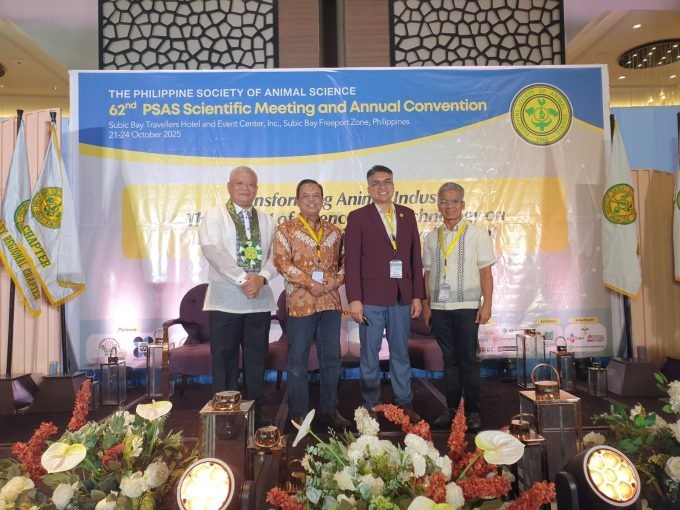
Prof. Dr. Ir. Bambang Suwignyo, S.Pt., M.P., IPM., ASEAN Eng., a lecturer from the Faculty of Animal Science in UGM, attended the 62nd Philippine Society of Animal Science (PSAS) Scientific Meeting and Annual Convention. Held from October 21-24, 2025, at the Subic Bay Travelers Hotel and Events in the Subic Freeport Zone, Zambales, Philippines, the event was supported by a SEARCA Travel Grant.
The overarching theme of this annual seminar was “Transforming Animal Industry: The Impact of Science and Technology on Business and Sustainable Development”.
The event served as an annual gathering bringing together key stakeholders in the livestock industry, ranging from academics, research institutions, and funding agencies to national and local government bodies, private companies, and livestock farmers, to discuss the future challenges and opportunities facing the industry in the Philippines.
At the forum, Prof. Bambang was specially invited as a resource speaker to present on the topic “Production and Utilization of Tropical Alfalfa in Livestock and Poultry Feeding”. He participated in his capacity as an expert and the inventor of tropical alfalfa, a contribution recognized both nationally and internationally.
Alfalfa (Medicago sativa) is a legume widely recognized as highly nutritious feed for horses, beef cattle, and dairy cattle. Globally, it is known as the “queen of forage”.
Historically, the plant originated in the Middle East and North Africa before being introduced to Spain by the Moors in 711 AD. From there, it spread to South America via Spanish expeditions in the 16th century. Known as Al-Fisfisa in Arabic, the name evolved into alfalfa in Spanish, signifying the “father of all foods”. In Europe, the plant is also known as Lucerne.
From Indonesia to the World: A Tropical Alfalfa Variety Developed by Indonesian Talent
Since 2010, Prof. Bambang Suwignyo has been researching and developing a tropical alfalfa variety capable of thriving in hot, humid climates.
The results of this extensive research were officially recognized by the government in 2021 through a germplasm certificate issued by the Center for Plant Variety Protection and Agriculture Licensing under the Indonesian Ministry of Agriculture, designating the variety as Kacang Ratu BW (Medicago sativa cv. Kacang Ratu BW).
Research findings on tropical alfalfa have been published in scientific journals and disseminated via social media, gaining widespread recognition abroad, including in the Philippines. Researchers in the Philippines, particularly those specializing in dairy cattle, have been in contact with Prof. Bambang since 2019 to explore potential research collaborations. Although these plans were delayed by the COVID-19 pandemic, they finally came to fruition at this year’s PSAS forum.
Research Findings: Evidence of Tropical Alfalfa’s Superiority
In his presentation at PSAS, Bambang Suwignyo shared various research findings confirming alfalfa’s status as the “queen of forage”.
Trials involving dairy goats demonstrated that tropical alfalfa yields competitive results compared to other popular legumes such as Indigofera and Calliandra.
Research was also conducted on laying hens and ducks, showing that incorporating alfalfa as a functional feed ingredient reduced cholesterol levels in meat, blood, and liver compared to standard commercial feed.
“This also dispels the long-standing myth that alfalfa can only grow in subtropical regions or requires long days. The facts show that, with genetic adaptation and proper cultivation management, alfalfa can thrive in tropical regions like Indonesia,” said Bambang on Friday (25/10).
Beyond the seminar sessions, Prof. Bambang also received several proposals for collaboration on tropical alfalfa research and development from four institutions in the Philippines: the University of Science and Technology of Southern Philippines (Apolinario Babia Gonzaga), USTP Claveria, Mindanao (Imelda Hebron), the Institute of Animal Science at the University of the Philippines Los Baños College of Agriculture (Arnel del Nario), and the Faculty of Agriculture at the University of Southern Mindanao (Jurhamid C. Iman).
If these collaborations come to fruition, the move will not only expand research networks but also mark a new chapter in which Indonesian-developed tropical alfalfa is ready to make its mark on the global stage.
This aligns with the motto Prof. Bambang upholds: Non scholae sed vitae discimus; we learn not for school, but for life.
Original article: https://fapet.ugm.ac.id/alfalfa-tropik-dan-peluang-kerja-sama-internasional/
Translated by: Sarah Suminar