• About UGM
  • Academic Portal
  • IT Centre
  • Library
  • LPPM
  • Webmail
  • English
    • Indonesia
Universitas Gadjah Mada Faculty of Animal Science
Universitas Gadjah Mada
  • Home
  • About Us
    • Overviews
    • History
    • Visions and Missions
    • Ethical Values
    • Faculty Management
    • Faculty Members
    • Supporting Staff
    • Program and Centers
    • Campus Fasilities
  • Academic
    • Admission
    • Departments
      • Animal Nutrition and Feed Science
      • Livestock Socio-Economics
      • Animal Products Technology
      • Animal Breeding and Reproduction
      • Animal Production
    • Study Programs
      • Undergraduate Program
      • International Undergraduate Program
      • Graduate Program
      • Engineering Program
    • Accreditation
    • Summer Program
    • Supporting Unit
    • Academics Calendar
    • Student
      • Student Organization
      • Student Housing
      • International Exposure
      • Scholarship
  • Research
    • Published Journal
    • Publications
    • Presentations
    • Books and Chapters
  • Network
    • International
      • Universities
      • Government
      • Consortium
    • National
      • Universities
      • Government
      • Consortium
  • Alumni
    • Alumni Service
    • Alumni Community
    • Job and Internship
  • FAQ
  • Home
  • Faculty News
  • FAS UGM Students Create Particle Board Prototypes Made from Chicken Feather Waste and Plastic Bottles

FAS UGM Students Create Particle Board Prototypes Made from Chicken Feather Waste and Plastic Bottles

  • Faculty News
  • 2 December 2019, 16.06
  • Oleh:
  • 0

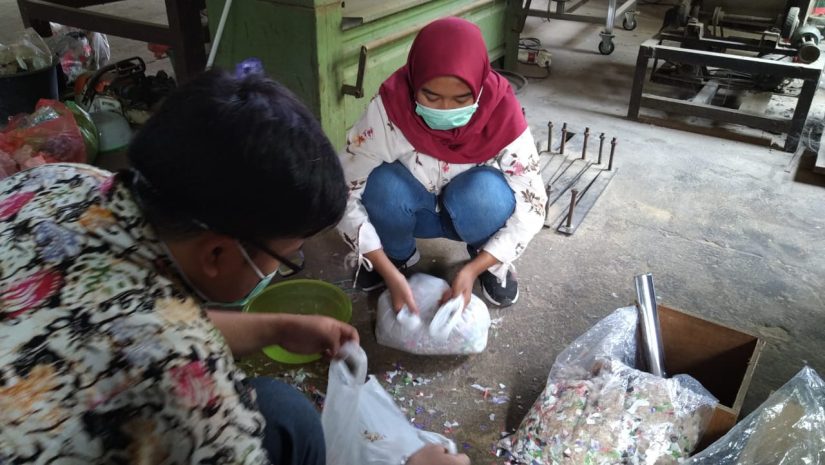
Three students of Faculty of Animal Science (FAS) UGM (Imaniar Rusyadi, Fahmi Arrasyid, and Dian Setya Budi), created a particle board prototype based on chicken feathers waste and disposable plastic bottles.

“This innovative product was made as one of the solutions to environmental problems caused by both wastes, which is difficult to decompose naturally. In addition, the availability of both wastes is abundant. According to data from the Central Statistics Agency (2019), broiler production in Indonesia in 2018 will reach 2,144,013 tons. Production of broiler chicken feathers per tail is 9.6% so it can be projected to volume chicken feathers in a year. The production of plastic waste in Indonesia has also reached a serious stage, which is 64 million tons per year and is the second largest in the world,” Imaniar said when met at the FAS UGM campus Friday (11/29).

Imaniar Rusyadi as the lead researcher of the innovative product explained that the two wastes have not been widely used so that they are potentially used as substitutes for particle board products made from forest wood with synthetic adhesives.

“The high demand for processed wood products has caused a drastic reduction in the area of ​​forest land. According to data from the Indonesian Ministry of Environment and Forestry, in 2014-2015, there was a decrease in the area of ​​forest land reaching 0.82 million hectares,” he said.

In addition, synthetic adhesives commonly used are formaldehyde derived from refined petroleum. At present, the source of raw materials is reduced and formaldehyde emissions need to be considered.

Chicken feathers, which mainly consist of keratin protein, function as fillers, which are ingredients that provide volume and strength. The properties of keratin fibers are non-abrasive, environmentally friendly, can be decomposed naturally, inexpensive, insoluble in organic solvents, have good mechanical strength, low density, and are waterproof. Waste plastic bottles composed of Polypropylene Therephthalate (PET) function as an adhesive or matrix. The ratio between filler and matrix is ​​75:25.

According to Imaniar, the particle board called Eco-Palapa offers several advantages. “First, environmentally friendly. Second, waterproof. Keratin in chicken feathers and PET have hydrophobic properties and are not preferred by termites. Meanwhile, wood particle board can bind with water which causes it to rot easily. Third, light. The particle board is composed of keratin and PET disposable plastic bottles that have gone through a hydration process during hot forging. Fourth, heat resistance. Eco-Palapa is composed of a dense braid of chicken feathers and PET which have high resistance to heat,” Imaniar explained.

Eco-Palapa can fulfill the benefits of three aspects, namely economic, social and environmental. The product is able to provide profits from sales and can increase the income of chicken slaughterhouses and plastic waste processors by working together to sell raw materials in the form of chicken feather waste and disposable plastic bottle counts. From a social perspective, new relationships will be established between raw material distributors, producers, finished particle board distributors, and consumers. In terms of environmental aspects, Eco-Palapa helps reduce the accumulation of organic and inorganic waste that disturbs the environmental balance.

Eco-Palapa is an innovative product that has the potential to get a patent. These potentials are new, inventive, applicable and applicable in the industry. Imaniar Rusyadi is optimistic that Eco-Palapa can be produced continuously given the abundant availability of chicken feather waste and disposable plastic bottles.

Products developed by the three students won 3rd place in the Teuku Umar University (UTU) Awards in the category of Agriculture and Maritime-Based Innovative Products in mid-November 2019. (Nadia)

Post Views: 295

Leave A Comment Cancel reply

Your email address will not be published. Required fields are marked *

*

This site uses Akismet to reduce spam. Learn how your comment data is processed.

Latest Post

  • Four Fapet UGM Students Joined Leather Tanning Training Program in Europe
  • The Faculty of Animal Science in UGM Holds a Discussion Forum on Poultry Industry Transformation and Optimization of IDR 20 Trillion Budget
  • Faculty of Animal Science in UGM Receives a Comparative Study from Faculty of Animal Science and Fisheries in Unsulbar, Discusses Opportunities for Academic and Research Collaboration
  • Laboratorium Assistant of the Faculty of Animal Science Develops Online Micro-Credential-Based Urban Farming Module 
  • Faculty of Animal Science Graduates Encouraged to Become Thought Leaders 

UGM News

  • Outstanding Achievement: Chip Vendor’s Daughter Earns Full Scholarship to Study Medicine at UGM
  • UGM KKN Students Launch BlueCoast Eco Festival to Promote Sustainable Tourism in South Buton
  • UGM Strengthens Academic Governance to Enhance Global Recognition
  • Global Summer Week 2026 at FEB UGM Unites Students from Five Countries
  • Why Indonesian Donations Stay High Despite Economic Hardship
Universitas Gadjah Mada

Faculty of Animal Science, Universitas Gadjah Mada
Jl. Fauna No. 3 Bulaksumur, Yogyakarta 55281
Telp: (0274) 513363 | Fax: (0274) 521578 |

Email: fapet@ugm.ac.id

UNDUH

Sertifikat BAN PT S1- 2009 2014

Sertifikat BAN PT S1 – 14 Sep 2014-14 Sep 2019

Formulir Akademik dan Kemahasiswaan

Dokumen MBKM

Sertifikat BAN PT

Sertifikat BAN PT Unggul

Sertifikat ASIIN

Buku Panduan Akademik Kurikulum 2021 Edisi Tahun 2024

Buku Panduan PKL 2023

Buku Panduan Proposal

Buku Panduan Skripsi

Pernyataan Keaslian Tugas Akhir

Unduh selengkapnya…

Visit Fapet

  • Campus Map
  • Event

Registration

  • Undergraduate
  • Graduate
  • Diploma
  • Professional Progam
  • International

Download

Academic and Student Forms

Undergraduate Thesis Writing Guidebook 2017

MBKM Documents

MBKM Guide Book

BAN PT Certificate

BAN PT Excellent Certificate

ASIIN Certificate

Academic Guidebook Curriculum 2021 Year 2023

More …

© 2018 Faculty of Animal Science UGM

KEBIJAKAN PRIVASI/PRIVACY POLICY

WhatsApp us

[EN] We use cookies to help our viewer get the best experience on our website. -- [ID] Kami menggunakan cookie untuk membantu pengunjung kami mendapatkan pengalaman terbaik di situs web kami.I Agree / Saya Setuju